Buyology: Truth and Lies About Why We Buy
Business & Investing, Martin Lindstrom
Buyology: Truth and Lies About Why We Buy par Martin Lindstrom ont été vendues pour EUR 10,83 chaque exemplaire. Le livre publié par Crown Business. Il contient 272 pages et classé dans le genre genre. Ce livre a une bonne réponse du lecteur, il a la cote 4.6 des lecteurs 805. Inscrivez-vous maintenant pour accéder à des milliers de livres disponibles pour téléchargement gratuit. L'inscription était gratuite.
Moyenne des commentaires client : 4.6 étoiles sur 5 805 commentaires client
La taille du fichier : 27.37 MB
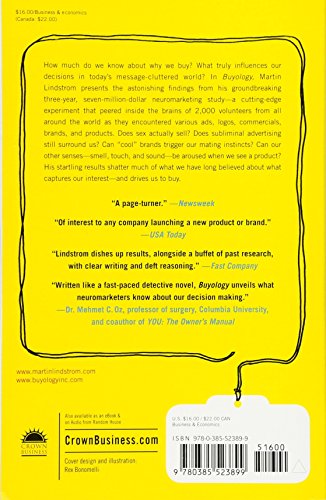
Buyology: Truth and Lies About Why We Buy Martin Lindstrom texte complet - Book by Lindstrom MartinRang parmi les ventes Amazon: #29076 dans LivresMarque: Brand: Crown BusinessPublié le: 2010-02-02Sorti le: 2010-02-02Langue d'origine: AnglaisNombre d'articles: 1Dimensions: 8.10" h x .73" l x 5.20" L, .51 livres Reliure: Broché272 pagesExtraitNot surprisingly, the smokers were on edge, fidgety, not sure what to expect. Barely noticing the rain and overcast skies, they clumped together outside the medical building in London, England, that houses the Centre for NeuroImaging Sciences. Some were self- described social smokers–a cigarette in the morning, a second snuck in during lunch hour, maybe half-a- dozen more if they went out carousing with their friends at night. Others confessed to being longtime two-pack-a-day addicts. All of them pledged their allegiance to a single brand, whether it was Marlboros or Camels. Under the rules of the study, they knew they wouldn’t be allowed to smoke for the next four hours, so they were busy stockpiling as much tar and nicotine inside their systems as they could. In between drags, they swapped lighters, matches, smoke rings, apprehensions: Will this hurt? George Orwell would love this. Do you think the machine will be able to read my mind? Inside the building, the setting was, as befits a medical laboratory, antiseptic, no- nonsense, and soothingly soulless–all cool white corridors and flannel gray doors. As the study got under way I took a perch behind a wide glass window inside a cockpit-like control booth among a cluster of desks, digital equipment, three enormous computers, and a bunch of white-smocked researchers. I was looking over a room dominated by an fMRI (functional Magnetic Resonance Imaging) scanner, an enormous, $4 million machine that looks like a giant sculpted doughnut, albeit one with a very long, very hard tongue. As the most advanced brain- scanning technique available today, fMRI measures the magnetic properties of hemoglobin, the components in red blood cells that carry oxygen around the body. In other words, fMRI measures the amount of oxygenated blood throughout the brain and can pinpoint an area as small as one millimeter (that’s 0.03937 of an inch). You see, when a brain is operating on a specific task, it demands more fuel–mainly oxygen and glucose. So the harder a region of the brain is working, the greater its fuel consumption, and the greater the flow of oxygenated blood will be to that site. So during fMRI, when a portion of the brain is in use, that region will light up like a red-hot flare. By tracking this activation, neuroscientists can determine what specific areas in the brain are working at any given time. Neuroscientists traditionally use this 32-ton, SUV-sized instrument to diagnose tumors, strokes, joint injuries, and other medical conditions that frustrate the abilities of X-rays and CT scans. Neuropsychiatrists have found fMRI useful in shedding light on certain hard-to-treat psychiatric conditions, including psychosis, sociopathy, and bipolar illness. But those smokers puffing and chatting and pacing in the waiting room weren’t ill or in any kind of distress. Along with a similar sample of smokers in the United States, they were carefully chosen participants in a groundbreaking neuromarketing study who were helping me get to the bottom–or the brain–of a mystery that had been confounding health professionals, cigarette companies, and smokers and nonsmokers alike for decades. For a long time, I’d noticed how the prominently placed health warnings on cigarette boxes seemed to have bizarrely little, if any, effect on smokers. Smoking causes fatal lung cancer. Smoking causes emphysema. Smoking while pregnant causes birth defects. Fairly straightforward stuff. Hard to argue with. And those are just the soft- pedaled American warnings. European cigarette makers place their warnings in coal-black, Magic Marker—thick frames, making them even harder to miss. In Portugal, dwarfing the dromedary on Camel packs, are words even a kid could understand: Fumar Mata. Smoking kills. But nothing comes even close to the cigarette warnings from Canada, Thailand, Australia, Brazil–and soon the U.K. They’re gorily, forensically true-to-life, showing full- color images of lung tumors, gangrenous feet and toes, and the open sores and disintegrating teeth that accompany mouth and throat cancers. You’d think these graphic images would stop most smokers in their tracks. So why, in 2006, despite worldwide tobacco advertising bans, outspoken and frequent health warnings from the medical community, and massive government investment in antismoking campaigns, did global consumers continue to smoke a whopping 5,763 billion cigarettes, a figure which doesn’t include duty-free cigarettes, or the huge international black market trade? (I was once in an Australian convenience store where I overheard the clerk asking a smoker, “Do you want the pack with the picture of the lungs, the heart, or the feet?” How often did this happen, I asked the clerk? Fifty percent of the time that customers asked for cigarettes, he told me.) Despite what is now known about smoking, it’s estimated that about one-third of adult males across the globe continue to light up. Approximately 15 billion cigarettes are sold every day–that’s 10 million cigarettes sold a minute. In China, where untold millions of smokers believe that cigarettes can cure Parkinson’s disease, relieve symptoms of schizophrenia, boost the efficacy of brain cells, and improve their performance at work, over 300 million people,1 including 60 percent of all male doctors, smoke. With annual sales of 1.8 trillion cigarettes, the Chinese monopoly is responsible for roughly one-third of all cigarettes being smoked on earth today2–a large percentage of the 1.4 billion people using tobacco, which, according to World Bank projections, is expected to increase to roughly 1.6 billion by 2025 (though China consumes more cigarettes than the United States, Russia, Japan, and Indonesia combined). In the Western world, nicotine addiction still ranks as an enormous concern. Smoking is the biggest killer in Spain today, with fifty thousand smoking- related deaths annually. In the U.K., roughly one-third of all adults under the age of sixty-five light up, while approximately 42 percent of people under sixty-five are exposed to tobacco smoke at home.3 Twelve times more British people have died from smoking than died in World War II. According to the American Lung Association, smoking- related diseases affect roughly 438,000 American lives a year, “including those affected indirectly, such as babies born prematurely due to prenatal maternal smoking and victims of ‘secondhand’ exposure to tobacco’s carcinogens.” The health-care costs in the United States alone? Over $167 billion a year.4 And yet cigarette companies keep coming up with innovative ways to kill us. For example, Philip Morris’s latest weapon against workplace smoking bans is Marlboro Intense, a smaller, high-tar cigarette–seven puffs worth–that can be consumed in stolen moments in between meetings, phone calls, and PowerPoint presentations.5 It makes no sense. Are smokers selectively blind to warning labels? Do they think, to a man or a woman, Yes, but I’m the exception here? Are they showing the world some giant act of bravado? Do they secretly believe they are immortal? Or do they know the health dangers and just not care? That’s what I was hoping to use fMRI technology to find out. The thirty-two smokers in today’s study? They were among the 2,081 volunteers from America, England, Germany, Japan, and the Republic of China that I’d enlisted for the largest, most revolutionary neuromarketing experiment in history. It was twenty-five times larger than any neuromarketing study ever before attempted. Using the most cutting-edge scientific tools available, it revealed the hidden truths behind how branding and marketing messages work on the human brain, how our truest selves react to stimuli at a level far deeper than conscious thought, and how our unconscious minds control our behavior (usually the opposite of how we think we behave). In other words, I’d set off on a quest to investigate some of the biggest puzzles and issues facing consumers, businesses, advertisers, and governments today. For example, does product placement really work? (The answer, I found out, is a qualified no.) How powerful are brand logos? (Fragrance and sound are more potent than any logo alone.) Does subliminal advertising still take place? (Yes, and it probably influenced what you picked up at the convenience store the other day.) Is our buying behavior affected by the world’s major religions? (You bet, and increasingly so.) What effect do disclaimers and health warnings have on us? (Read on.) Does sex in advertising work (not really) and how could it possibly get more explicit than it is now? (You just watch.) Beginning in 2004, from start to finish, our study took up nearly three years of my life, cost approximately $7 million (provided by eight multinational companies), comprised multiple experiments, and involved thousands of subjects from across the globe, as well as two hundred researchers, ten professors and doctors, and an ethics committee. And it employed two of the most sophisticated brain- scanning instruments in the world: the fMRI and an advanced version of the electroencephalograph known as the SST, short for steady-state typography, which tracks rapid brain waves in real time. The research team was overseen by Dr. Gemma Calvert, who holds the Chair in Applied Neuroimaging at the University of Warwick, England, and is the founder of Neurosense in Oxford, and Professor Richard Silberstein, the CEO of Neuro-Insight in Australia. And the results? Well, all I’ll say for now is that they’ll transform the way you think about how and why you buy. Marlene, one of the smokers in the study, took her place lying flat on her back inside the fMRI. The machine made a little ticking sound as the platform rose and locked into place. Marlene looked a little hesitant–who wouldn’t?–but managed a gung-ho smile as a technician placed the protective head coil over most of her face in preparation for the first brain scan of the day. From Marlene’s pretesting questionnaire and interview, I knew she was a recently divorced mother of two from Middlesex, and that she’d started smoking at boarding school fifteen years earlier. She thought of herself less as a nicotine addict than a “party smoker,” that is, she smoked just a couple of “small” cigarettes during the day, as well as eight to ten more at night. “Are you affected by the warnings on cigarette packs?” the questionnaire had asked. “Yes,” Marlene had written, twirling her pen around in her fingers as though she was about to ignite the thing. “Are you smoking less as a consequence of these?” Another yes. More pen-spinning. I’ve never been a smoker, but I felt for her. Her interview answers were clear enough, but now it was time to interview her brain. For those who’ve never had an MRI, it’s not what I’d call the most relaxing or enjoyable experience in the world. The machine is clankingly noisy, lying perfectly still is tedious, and if you’re at all prone to panic or claustrophobia, it can feel as if you’re being buried alive in a phone booth. Once inside, it’s best you remain in a state of yogic calm. Breathe. In, out, in again. You’re free to blink and swallow, but you better ignore that itch on your left calf if it kills you. A tic, a jiggle, a fidget, a grimace, body twitching– the slightest movement at all and the results can be compromised. Wedding bands, bracelets, necklaces, nose rings, or tongue studs have to be taken off beforehand, as well. Thanks to the machine’s rapacious magnet, any scrap of metal would rip off so fast you wouldn’t know what just belted you in the eye. Marlene was in the scanner for a little over an hour. A small reflective apparatus resembling a car’s rearview mirror projected a series of cigarette warning labels from various angles, one after another, on a nearby screen. Asked to rate her desire to smoke during this slideshow, Marlene signaled her responses by pressing down on what’s known as a button box– a small black console resembling a hand-sized accordion–as each image flashed by. We continued to perform brain scans on new subjects over the next month and a half. Five weeks later, the team leader, Dr. Calvert, presented me with the results. I was, to put it mildly, startled. Even Dr. Calvert was taken aback by the findings: warning labels on the sides, fronts, and backs of cigarette packs had no effect on suppressing the smokers’ cravings at all. Zero. In other words, all those gruesome photographs, government regulations, billions of dollars some 123 countries had invested in nonsmoking campaigns, all amounted, at the end of a day, to, well, a big waste of money. “Are you sure?” I kept saying. “Pretty damn certain,” she replied, adding that the statistical validity was as solid as could be. But this wasn’t half as amazing as what Dr. Calvert discovered once she analyzed the results further. Cigarette warnings–whether they informed smokers they were at risk of contracting emphysema, heart disease, or a host of other chronic conditions–had in fact stimulated an area of the smokers’ brains called the nucleus accumbens, otherwise known as “the craving spot.” This region is a chain-link of specialized neurons that lights up when the body desires something–whether it’s alcohol, drugs, tobacco, sex, or gambling. When stimulated, the nucleus accumbens requires higher and higher doses to get its fix. In short, the fMRI results showed that cigarette warning labels not only failed to deter smoking, but by activating the nucleus accumbens, it appeared they actually encouraged smokers to light up. We couldn’t help but conclude that those same cigarette warning labels intended to curb smoking, reduce cancer, and save lives had instead become a killer marketing tool for the tobacco industry. Most of the smokers checked off yes when they were asked if warning labels worked–maybe because they thought it was the right answer, or what the researchers wanted to hear, or maybe because they felt guilty about what they knew smoking was doing to their health. But as Dr. Calvert concluded later, it wasn’t that our volunteers felt ashamed about what smoking was doing to their bodies; they felt guilty that the labels stimulated their brains’ craving areas. It was just that their conscious minds couldn’t tell the difference. Marlene hadn’t been lying when she filled out her questionnaire. But her brain–the ultimate no-bullshit zone–had adamantly contradicted her. Just as our brains do to each one of us every single day. The results of the additional brain scan studies I carried out were just as provocative, fascinating, and controversial as the cigarette research project. One by one, they brought me closer to a goal I’d set out to accomplish: to overturn some of the most long-held assumptions, myths, and beliefs about what kinds of advertising, branding, and packaging actually work to arouse our interest and encourage us to buy. If I could help uncover the subconscious forces that stimulate our interest and ultimately cause us to open our wallets, the brain-scan study would be the most important three years of my life. By way of profession, I’m a global branding expert. That is, it’s been a lifelong mission (and passion) to figure out how consumers think, why they buy or don’t buy the products they do–and what marketers and advertisers can do to pump new life into products that are sick, stuck, stumbling, or just lousy to begin with. If you look around, chances are pretty good you’ll find my branding fingerprints are all over your house or apartment, from those products under the kitchen sink, to the chocolate you stash in your desk drawer, to the phone beside your bed, to the shaving cream in your bathroom, to the car sitting in the driveway. Maybe I helped brand your TV’s remote control. The coffee you gulped down this morning. The bacon cheeseburger and French fries you ordered in last week. Your computer software. Your espresso machine. Your toothpaste. Your dandruff shampoo. Your lip balm. Your underwear. Over the years I’ve been doing this work, I’ve helped brand antiperspirant, feminine hygiene products, iPod speakers, beer, motorcycles, perfume, Saudi Arabian eggs–the list goes on and on. As a branding expert and brand futurist (meaning that the sum of my globe- hopping experience gives me a helicopter view of probable future consumer and advertising trends), businesses consider my colleagues and me something of a brand ambulance service, a crisis- intervention management team. Let’s say that your line of pricey bottled water from the Silica-Filled- Crystal-Clear- Mountain-Streams-and- Artesian-Wells-of- Wherever is tanking. The company wants consumers to believe it’s bottled by elves standing ankle-deep in fjords rather than inside a sprawling plant off the New Jersey Turnpike, but regardless, its market shares are tumbling, and no one in the company knows what to do. I’ll begin digging. What’s the secret of their product? What makes it stand out? Are there any stories or rituals or mysteries consumers associate with it? If not, can we root around and find some? Can the product somehow break through the two- dimensional barrier of advertising by appealing to senses the company hasn’t yet thought of? Smell, touch, sound? A gasp the cap makes when you unscrew it? A flirty pink straw? Is the advertising campaign edgy and funny and risk- taking, or is it as boring and forgettable as every other company’s? Because I travel so much, I’m able to see how brands perform all over the world. I’m on an airplane about three hundred days out of the year, giving presentations, analyses, and speeches. If it’s Tuesday, I could be in Mumbai. The next day São Paolo. Or Dublin, Tokyo, Edinburgh, San Francisco, Athens, Lima, Sri Lanka, or Shanghai. But my hectic travel schedule is an advantage I can bring to a team that’s usually too busy to go outside their own building for lunch, much less visit a store in Rio de Janeiro or Amsterdam or Buenos Aires to observe their product in action.I’ve been told more times than I can count that my appearance is as nonconventional as what I do for a living. At thirty-eight, I stand about five feet eight inches, and am blessed, or cursed, with an extremely young, boyish-looking face. The excuse I’ve come up with over the years is that I grew up in Denmark, where it was so cold all the time the weather froze my looks in place. My features, my raked-back blond hair, and my habit of wearing all black give a lot of people the impression that I’m some kind of quirky child evangelist, or maybe some precocious, slightly wired high-school student who got lost on the way to the science lab and ended up in a corporate boardroom by mistake. I’ve gotten used to this over the years. I suppose you could say that it’s evolved into my brand. So how did I find myself staring through a window into an antiseptic medical lab in a rain-soaked English university as one volunteer after another submitted to an fMRI brain scan? By 2003, it had become pretty clear to me that traditional research methods, like market research and focus groups, were no longer up to the task of finding out what consumers really think. And that’s because our irrational minds, flooded with cultural biases rooted in our tradition, upbringing, and a whole lot of other subconscious factors, assert a powerful but hidden influence over the choices we make. Like Marlene and all those other smokers who said that cigarette warnings discouraged them from smoking, we may think we know why we do the things we do–but a much closer look into the brain tells us otherwise. Think about it. As human beings, we enjoy thinking of ourselves as a rational species. We feed and clothe ourselves. We go to work. We remember to turn down the thermostat at night. We download music. We go to the gym. We handle crises–missed deadlines, a child falling off a bike, a friend getting sick, a parent dying, etc.–in a grown-up, evenhanded way. At the least, that’s our goal. If a partner or colleague accuses us of acting irrationally, we get a little offended. They might as well have just accused us of temporary insanity. But like it or not, all of us consistently engage in behavior for which we have no logical or clear-cut explanation. This is truer than ever before in our stressed-out, technologically overwired world, where news of terrorist threats, political saber- rattling, fires, earthquakes, floods, violence, and assorted other disasters pelts us from the moment we turn on the morning news to the time we go to bed. The more stress we’re under, the more frightened and insecure and uncertain we feel–and the more irrationally we tend to behave. For example, consider how much superstition governs our lives. We knock on wood for luck. (I’ve been in boardrooms where, if there’s no wood around, executives will glance around helplessly for a substitute. Does a briefcase count? A pencil? What about the floor?) We won’t walk under ladders. We cross our fingers for luck. We’d prefer not to fly on Friday the thirteenth, or drive down the street where we spotted that black cat in the bushes last week. If we break a mirror, we think, That’s it, seven years of bad luck. Of course, if you ask us, most of us will say no, don’t be ridiculous, I give absolutely no credence to any of those inane superstitions. Yet most of us continue to act on them, every day of our lives. Under stress (or even when life is going along pretty well), people tend to say one thing while their behavior suggests something entirely different. Needless to say, this spells disaster for the field of market research, which relies on consumers being accurate and honest. But 85 percent of the time our brains are on autopilot. It’s not that we mean to lie–it’s just that our unconscious minds are a lot better at interpreting our behavior (including why we buy) than our conscious minds are. The concept of brand- building has been around for close to a century. But advertisers still don’t know much more than department store pioneer John Wanamaker did a century ago when he famously declared, “Half my advertising budget is wasted. Trouble is, I don’t know which half.” Companies often don’t know what to do to engage us authentically–as opposed to simply attracting our attention. I’m not saying companies aren’t smart, because they are. Some, like the tobacco companies, are scarily smart. But most still can’t answer a basic question: What drives us, as consumers, to make the choices we do? What causes us to choose one brand or product over another? What are shoppers really thinking? And since no one can come up with a decent answer to these questions, companies plow ahead using the same strategies and techniques as they always have. Marketers, for example, are still doing the same old stuff: quantitative research, which involves surveying lots and lots of volunteers about an idea, a concept, a product, or even a kind of packaging–followed by qualitative research, which turns a more intense spotlight on smaller focus groups handpicked from the same population. In 2005, corporations spent more than $7.3 billion on market research in the United States alone. In 2007, that figure rose to $12 billion. And that doesn’t even include the additional expenses involved in marketing an actual product–the packaging and displays, TV commercials, online banner ads, celebrity endorsements, and billboards–which carry a $117 billion annual price tag in America alone. But if those strategies still work, then why do eight out of ten new product launches fail within the first three months? (In Japan, product launches fail a miserable 9.7 times out of every ten.) What we know now, and what you’ll read about in the pages that follow, is that what people say on surveys and in focus groups does not reliably affect how they behave–far from it. Let’s take an example. Today’s modern mother is more and more fearful about “germs,” “safety,” and “health.” No woman in her right mind wants to accidentally ingest E. coli, or pick up strep throat, nor does she want little Ethan or Sophie to get infected either. So a company’s research department develops a small vial of something antibacterial–we’ll call it “Pure-Al”–that women can tuck in their pockets, and whip out to slather on their hands after a day spent in a suffocating office, a friend’s filthy apartment or an overcrowded subway car. But can Pure-Al really inhibit our fears about “germs” and “safety”? How can its marketers know what these terms mean to most of us? Sure, there’s a basic human desire to feel safe and secure, as well as a natural aversion to germ- ridden banisters, bacteria- laden jungle gyms, and dusty offices. But as our smokers’ questionnaires showed, we don’t always express or act on these feelings consciously; there’s an entire peninsula of thought and feeling that remains out of reach. The same goes for every single other emotion we experience, whether it’s love, empathy, jealousy, anger, revulsion, and so on. Tiny, barely perceptible factors can slant focus group responses. Maybe one woman felt that as a mother of four kids and three dogs and seventeen geckos, she should care more about germs, but didn’t want to admit to the other women in the room that her house was already messy beyond the pale. Or maybe the head of the research team reminded another woman of an ex- boyfriend who left her for her best friend and this (okay, just maybe) tainted her impression of the product. Maybe they just all hated his nose. Point is, try putting these micro- emotions into words or writing them down in a roomful of strangers. It can’t be done. That’s why the true reactions and emotions we as consumers experience are more likely to be found in the brain, in the nanosecond lapse before thinking is translated into words. So, if marketers want the naked truth–the truth, unplugged and uncensored, about what causes us to buy–they have to interview our brains. All of this is why, in 2003, I became convinced that something was fundamentally wrong with the ways companies reached out to customers, to us. Quite simply, companies didn’t seem to understand consumers. Companies couldn’t find and develop brands that matched our needs. Nor were they sure how to communicate in a way so that their products gripped our minds and hearts. Whether they were marketing cosmetics, pharmaceuticals, fast-food, cars, or pickles, no advertisers dared to stand out, or to try out anything remotely new or revolutionary. In terms of understanding the mind of the average consumer they were like Christopher Columbus in 1492, gripping a torn, hand-drawn map as the wind picked up and his boat lurched and listed toward what might or might not be flat land. By uncovering the brain’s deepest secrets, I wasn’t interested in helping companies manipulate consumers–far from it. I buy a lot of stuff, too, after all, and at the end of the day, I’m as susceptible to products and brands as anyone. I also want to sleep well at night, knowing I’ve done the right thing (over the years I’ve turned down projects that, in my opinion, crossed that line). By attempting to shine a spotlight on the buying behavior of over two thousand study subjects, I felt I could help uncover our minds’ truest motivations–and just maybe push human brain science forward at the same time. It was time to throw everything up in the air, see where it landed, then start all over again. Which is where our brain-scanning study came in. For me, it all began with a Forbes magazine cover story, “In Search of the Buy Button,” which I picked up during a typical daylong airplane flight. The article chronicled the goings-on in a small lab in Greenwich, England, where a market researcher had joined forces with a cognitive neuroscientist to peer inside the brains of eight young women as they watched a TV show interspersed with half-a- dozen or so commercials for products ranging from Kit Kat chocolates, to Smirnoff vodka, to Volkswagen’s Passat. Using a technique known as SST, which measures electrical activity inside the brain (and resembles, I later found out, a floppy black Roaring Twenties—era bathing cap), the scientist and researcher had focused on a sequence of wiry lines crawling across a computer, like two garter snakes engaged in a mating dance. Only these weren’t snakes, but brain waves, which SST was measuring millisecond-by- millisecond, in real time, as the volunteers viewed the commercials. An abrupt spike in one woman’s left prefrontal cortex might indicate to researchers that she found Kit Kats appealing or appetizing. A sharp drop later on, and the neurologist might infer the last thing in the world she wanted was a Smirnoff-on-the-rocks.6 Brain waves as calibrated by SST are straight shooters. They don’t waver, hold back, equivocate, cave in to peer pressure, conceal their vanity, or say what they think the person across the table wants to hear. No: like fMRI, SST was the final word on the human mind. You couldn’t get any more cutting-edge than this. In other words, neuroimaging could uncover truths that a half- century of market research, focus groups, and opinion polling couldn’t come close to accomplishing. I was so excited by what I was reading I nearly rang the call button just so I could tell the steward. As I mentioned earlier, eight out of every ten products launched in the United States are destined to fail. In 2005, more than 156,000 new products debuted in stores globally, the equivalent of one new product release every three minutes.7 Globally, according to the IXP Marketing Group, roughly 21,000 new brands are introduced worldwide per year, yet history tells us that all but a few of them have vanished from the shelf a year later.8 In consumer products alone, 52 percent of all new brands, and 75 percent of individual products, fail.9 Pretty terrible numbers. Neuroimaging, I realized, could zero in on those with the highest chance of succeeding by pinpointing consumers’ reward centers and revealing which marketing or advertising efforts were most stimulating, appealing, or memorable, and which ones were dull, off- putting, anxiety- provoking, or worst of all, forgettable. Market research wasn’t going away, but it was about to take a seat at the neuroscience table and in the process, take on a brainy new look. *** In 1975, Watergate was still scandalizing America. Margaret Thatcher was elected the leader of the conservative party in Great Britain. Color TV debuted in Australia. Bruce Springsteen came out with Born to Run. And executives at the Pepsi-Cola Company decided to roll out a heavily publicized experiment known as the Pepsi Challenge. It was very simple. Hundreds of Pepsi reps set up tables in malls and supermarkets all over the world, handing out two unmarked cups to every man, woman, and child who’d stopped to see what all the commotion was about. One cup contained Pepsi, the other Coke. The subjects were asked which one they preferred. If the results worked out as they hoped, Pepsi might finally make a dent in Coke’s longtime domination of the estimated $68 billion U.S. soft drink industry. When the company’s marketing department finally toted up the results, Pepsi executives were pleased, if slightly perplexed. More than half of the volunteers claimed to prefer the taste of Pepsi over Coke. Hallelujah, right? So by all accounts, Pepsi should be trouncing Coke all across the world. But it wasn’t. It made no sense. In his 2005 best- seller, Blink, Malcolm Gladwell offers a partial interpretation. The Pepsi Challenge was a “Sip Test,” or what’s known in the soda industry as a “Central Location Test,” or CLT. He cites a former Pepsi new- product development executive, Carol Dollard, who explains the difference between taking a sip of a soft drink out of a cup and downing the entire can. In a sip test, people tend to like the sweeter product–in this case Pepsi–but when they drink an entire can of the stuff, there always lurks the possibility of blood sugar— overkill. That, according to Gladwell, is why Pepsi prevailed in the taste test, but Coke continued to lead the market.10 But in 2003, Dr. Read Montague, the director of the Human Neuroimaging Lab at Baylor College of Medicine in Houston, decided to probe the test results more deeply. Twenty-eight years after the original Pepsi Challenge, he revised the study, this time using fMRI to measure the brains of his sixty- seven study subjects. First, he asked the volunteers whether they preferred Coke, Pepsi, or had no preference whatsoever. The results matched the findings of the original experiment almost exactly; more than half of the test subjects reported a marked preference for Pepsi. Their brains did, too. While taking a sip of Pepsi, this entirely new set of volunteers registered a flurry of activity in the ventral putamen, a region of the brain that’s stimulated when we find tastes appealing. Interesting, but not all that dramatic–until a fascinating finding showed up in the second stage of the experiment. This time around, Dr. Montague decided to let the test subjects know whether they were sampling Pepsi or Coke before they tasted it. The result: 75 percent of the respondents claimed to prefer Coke. What’s more, Montague also observed a change in the location of their brain activity. In addition to the ventral putamen, blood flows were now registering in the medial prefrontal cortex, a portion of the brain responsible, among other duties, for higher thinking and discernment. All this indicated to Dr. Montague that two areas in the brain were engaged in a mute tug-of-war between rational and emotional thinking. And during that mini- second of grappling and indecision, the emotions rose up like mutinous soldiers to override respondents’ rational preference for Pepsi. And that’s the moment Coke won.11 All the positive associations the subjects had with Coca-Cola–its history, logo, color, design, and fragrance; their own childhood memories of Coke, Coke’s TV and print ads over the years, the sheer, inarguable, inexorable, ineluctable, emotional Coke-ness of the brand–beat back their rational, natural preference for the taste of Pepsi. Why? Because emotions are the way in which our brains encode things of value, and a brand that engages us emotionally–think Apple, Harley-Davidson, and L’Oréal, just for starters–will win every single time. That Dr. Montague’s study had proven a conclusive scientific link between branding and the brain took the scientific community by surprise . . . and you can bet advertisers began paying attention, too. A newborn but intriguing window into our thought patterns and decision-making processes was a few sips closer to becoming reality. A similar, but no less powerful neuromarketing experiment soon followed on the heels of the Coke—Pepsi study. Far north from Texas, four Princeton University psychologists were busy conducting another experiment, this one aimed at scanning subjects’ brains as they were presented with a choice: short-term immediate gratification versus delayed rewards. The psychologists asked a group of random students to choose between a pair of Amazon .com gift vouchers. If they picked the first, a $15 gift voucher, they would get it at once. If they were willing to wait two weeks for the $20 gift certificate, well, obviously they’d be getting more bang for their buck. The brain scans revealed that both gift options triggered activity in the lateral prefrontal cortex, the area of the brain that generates emotion. But the possibility of getting that $15 gift certificate now! caused an unusual flurry of stimulation in the limbic areas of most students’ brains–a whole grouping of brain structures that’s primarily responsible for our emotional life, as well as for the formation of memory. The more the students were emotionally excited about something, the psychologists found, the greater the chances of their opting for the immediate, if less immediately gratifying, alternative. Of course, their rational minds knew the $20 was logically a better deal, but–guess what–their emotions won out.12 Economists, too, want to understand the underlying decisions involved in what makes us behave as we do. Economic theory may be fairly sophisticated, but it’s come up against blocks similar to the ones advertising is confronting. “Finance and economic research has hit the wall,” explains Andrew Lo, who runs AlphaSimplex Group, a Cambridge, Massachusetts, hedge fund firm. “We need to get inside the brain to understand why people make decisions.”13 That’s because, just like market research, economic modeling is based on the premise that people behave in a pre dict ably rational way. But again, what’s beginning to show up in the fledgling world of brain scanning is the enormous influences our emotions have on every decision we make. Thus the interest in neuro- economics, the study of the way the brain makes financial decisions. Thanks to fMRI, it is giving unprecedented insight into how emotions–such as generosity, greed, fear, and well- being–impact economic decision-making. As George Loewenstein, a behavioral economist from Carnegie Mellon University, confirmed: “Most of the brain is dominated by automatic processes, rather than deliberate thinking. A lot of what happens in the brain is emotional, not cognitive.”14 *** It comes as no surprise that once neuroimaging had snagged the attention of the advertising world, it would find its way into other disciplines, too. In fact, politics, law enforcement, economics, and even Hollywood were already in on the action. Politicians’ interest in the fMRI–well, you could almost see it coming. Committees spend up to a billion dollars handcrafting an electable presidential candidate–and elections are increasingly won and lost by the tiniest fraction of a percentage point. Imagine having at your disposal a tool that could possibly pinpoint what goes on in the brains of registered voters. If you were involved in a campaign, you’d want to use it, right? Or so Tom Freedman, a strategist and senior advisor to the Clinton administration, must have thought when he founded a company known as FKF Applied Research. FKF is devoted to studying decision- making processes, and how the brain responds to leadership qualities. In 2003, his company used fMRI scanning to analyze public responses to campaign commercials during the run-up to the Bush- Kerry presidential campaign. Freedman’s test subjects looked at a selection of commercials for incumbent president George W. Bush and Massachusetts senator John Kerry; photographs of each candidate; images of the September 11 World Trade Center terrorist attacks; and former president Lyndon Johnson’s infamous 1964 “Daisy” ad in which a young girl is seen frolicking with a daisy as a nuclear explosion detonates. The results? Not surprisingly, the September 11 attack imagery and the “Daisy” ad triggered a noticeable, across-the-board increase in activity in voters’ amygdalas, a small brain region named after the Greek word for “almond,” which governs, among other things, fear, anxiety, and dread. Yet Freedman found that Republicans and Democrats reacted differently to ads replaying the September 11 attacks; the amygdalas of Democrats lit up far more noticeably than the amygdalas of Republicans. Marco Iacobini, the lead researcher and an associate professor at the Neuropsychiatric Institute, interpreted this odd discrepancy to Democrats’ fear that 9/11 was a nerve- wracking touch-point that could lead to George W. Bush’s reelection in 2004. Tom Freedman threw in the theory that in general, Democrats are a lot more unsettled by the idea of military force, which they associated with 9/11, than are most Republicans. But what was most interesting to Freedman was that his study also showed that scanning voters’ amygdalas could be beneficial in designing campaign ads, as playing on voters’ fear has been shown time and time again to be key in securing a politician’s win. After all, Johnson’s “Daisy” ad had helped to ensure his victory in 1964 by playing to the fear of nuclear war. And, as it turned out, history would repeat itself forty years later when the Republicans clinched victory in the 2004 election by sledgehammering the fear of terrorism into voters’ heads. Despite widespread cries that political advertising emphasize “optimism,” “hope,” “building up, not tearing down,” and so on, fear works. It’s what our brains remember. Although using brain- scanning technology to sway political decisions is in its infancy, I predict that the 2008 American presidential showdown will be the last-ever election to be governed by traditional surveys, and that by 2012, neuroscience will begin to dominate all election predictions. “These new tools could help us someday be less reliant on clichés and unproven adages. They’ll help put a bit more science in political science,” Tom Freedman commented.15 Hollywood, too, is fascinated by neuroscience. A Stanford University experimental neurobiologist, Steve Quartz, has studied subjects’ brains to see how they respond to trailers of movies that are weeks, if not months, away from general release. Are they memorable, catchy, provocative? Will they hook our attention? By exploring precisely what appeals to the brain’s reward center, studios can create the most provocative trailers, or even sculpt the end of the movie to reflect what appeals to us, the viewing public.16 So if you think films are formulaic now, fasten your seatbelts for Rocky 52. As for law enforcement? One California entrepreneur has come up with a neuroimaging spin on the widely used polygraph, or lie- detector, test with a product called the No Lie MRI. Its assumption, as any capable dissembler can tell you, is that it takes effort to lie. In other words, saying, “No, I didn’t cheat on you, darling,” or “I swear I used my blinker!” requires a stimulation of cognition–and thus a rush of oxygenated blood to the brain. Even the U.S. Pentagon has increased their research into an MRI-based lie detection program, partially funded by the Defense Advanced Research Projects Agency, which comes up with ingenious new tools and techniques for military use.17 But back to marketing. As we’ve seen, this fledgling science had already made some inroads. In 2002, for example, Daimler- Chrysler’s research center in the German town of Ulm used fMRIs to study the brains of consumers while showing them images of a series of automobiles, including Mini Coopers and Ferraris. And what they found was that as the subjects gazed at a slide of a Mini Cooper, a discrete region in the back area of the brain that responds to faces came alive. The fMRI had just pinpointed the essence of the Mini Cooper’s appeal. Above and beyond the car’s “wide bulldog stance,” “ultra- rigid body,” “1.6L 16-valve alloy engine,” and “6 airbags with side protection” (goodies lauded on the car’s Web site),18 the Mini Cooper registered in subjects’ brains as an adorable face. It was a gleaming little person, Bambi on four wheels, or Pikachu with an exhaust pipe. You just wanted to pinch its little fat metallic cheeks, then drive it away. There’s no doubt that babies’ faces have a strong effect on our brains. In a University of Oxford study involving an imaging technique known as magnetoencephalography, neuroscientist Morten L. Kringelbach asked 12 adults to carry out a computer task while the faces of infants and adults (similar in expression) flashed onto a nearby screen. According to Scientific American, “While the volunteers ultimately processed the faces using the brain regions that normally handle such a task, all the participants showed an early, distinct response to the infant faces alone.” More specifically, “Within one-seventh of a second, a spike in activity occurred in the medial orbitofrontal cortex, an area above the eye sockets linked to the detection of rewarding stimuli.” In other words, according to Kringelbach, the volunteers’ brains seemed to identify infants’ faces as somehow special.19 More intriguing revelations followed. Daimler-Chrysler researchers then displayed images of sixty-six different cars to a dozen men, again scanning their brains using the fMRI. This time, the sports cars stimulated the region of the brain associated with “reward and reinforcement” according to Henrik Walter, a psychiatrist and neuroscientist involved in the study. And what is often the most rewarding thing for guys? Sex. It seemed, just as male peacocks attract female mates with the iridescence of their back feathers, the males in this study subconsciously sought to attract the opposite sex with the low-rising, engine- revving, chrome pizzazz of the sports car. Walter even took it one step further, explaining that just as female birds reject male birds with scrawny plumages–the peacock-equivalent of a comb-over–in favor of the most preening, showstopping birds because the length and sheen of a male peacock’s plumage correlate directly to the bird’s vigor, virility, and social status, so do women prefer men with a showy, slinky sports car: “If you are strong and successful as an animal, you can afford to invest energy in such a pointless thing,” Walter points out. In essence, neuroscience revealed what I’d always believed: that brands are much more than just recognizable products wrapped in eye- catching designs. Yet at the time, all previous neuroimaging tests had focused on a particular product. The brain scan study I decided to undertake would be the first attempt to examine not just a specific brand–whether a Heineken, a Honda Civic, a Gillette razor, or a Q-tip–but to explore what the concept “brand” really means to our brains. If I could sneak a peek inside consumers’ heads to find out why some products worked, while others fell flat on their faces, I knew my study could not only transform the way companies designed, marketed, and advertised their products– but also help each one of us understand what is really going on inside our brains when we make decisions about what we buy. So what the heck was I supposed to do next? The obvious next stage was to find the best scientists–and the most sophisticated instruments around–to help me carry out this experiment. Ultimately, I decided to combine two methods, SST, the advanced version of the electro encephalograph; and fMRI. I chose these for a number of reasons. Neither instrument is invasive. Neither involves radiation. And both are able to measure the level of emotional attraction (or revulsion) we as consumers experience more precisely than any other tool available. FMRI, as I mentioned earlier, is able to pinpoint an area as small as one millimeter in the brain. In essence, it takes a miniature home movie of the brain every few seconds–and in as little as ten minutes can amass a spectacular amount of information. Meanwhile, the less expensive SST brings with it the advantage of being able to measure reactions instantaneously (while fMRI has a few seconds delay). This made SST ideal for registering brain activity while people are watching TV commercials and programs, or any other kind of visual stimuli happening in real time. Better yet, it’s portable and travel ready–a kind of movable laboratory (which, believe me, came in handy when we secured special, unprecedented permission from the Chinese government to scan the brains of Chinese consumers). Ultimately, we based our research on 102 fMRI scans and 1,979 SST studies. Why not half-and-half? A typical fMRI brain scan, which involves design, analysis, conducting the experiment, and interpreting the results, can be expensive. SST studies are far less costly. Even so, our fMRI studies were almost twice as extensive as any conducted to date. Until we began our research, no one had ever mixed and matched fMRI and SST on behalf of a broad-scale neuromarketing study. If you think of the brain as a house, any and all previous experiments were based on looking through a single window, but our wide- ranging study promised to cast its gaze through as many windows, cracks, floorboards, attic windows, and mouse holes as we could find. But this study wasn’t going to come cheap, and I knew that without corporate backing, it was dead in the water. But when I get an idea in my head that keeps me up at night, I’m persistent. Politely pushy, you might call it. Those twenty- seven messages on your answering machine? They’re all from me (sorry). Nevertheless, in spite of all my efforts, business after business turned me down. The people I approached were either intrigued-but-unconvinced, or intrigued-but-spooked. And of course, with a brain-scanning experiment this ambitious, backers weren’t without their ethical concerns. “Orwellian”–that’s the most frequently heard reaction when people hear the word neuromarketing. A recent New York Times Magazine cover story touching on the law and brain imaging noted a widespread fear among scholars that brain scanning is a “kind of super mind- reading device” that threatens the privacy and “mental freedom” of citizens.20 But to be honest, I didn’t share these ethical concerns. As I said in the introduction, neuromarketing isn’t about implanting ideas in people’s brains, or forcing them to buy what they don’t want to buy; it’s about uncovering what’s already inside our heads–our Buyology. Our willing volunteers were genuinely excited to take part in the birth of a new science. There were no complaints. No adverse reactions, no side effects, no health risks. Everyone knew what they were doing, and they were fully briefed before they signed on. And in the end, a hospital ethics committee oversaw every detail and aspect of our study, ensuring that nothing could go forward until we’d cleared it with them first. Finally, one company said they were willing to give neuromarketing a shot. Followed by another company. Then another. A few months later, I’d secured all the resources I needed from eight multinational corporations. Finally, I put in some money of my own. Now, I was faced with the largest operational and logistical headache I’ve ever come up against: finding a huge number of volunteers–2,081 at final count–from a handful of countries around the world. Why? First, I didn’t want anyone claiming that the sample population I came up with was in any way too narrow or limited. Plus, our research had to be global, because the work I do is global, and because in today’s world, companies and brands are global as well. So I settled on a final five countries: America, because it’s home to Madison Avenue and Hollywood; Germany, because it’s the most advanced country in the world as far as neuromarketing is concerned; England, because it’s where Dr. Calvert’s company is based; Japan, because there’s no rougher, tougher place in the world to launch a new product; and China, because it’s by far the world’s largest emerging market. Cut to a few months later, when I found myself in a Los Angeles studio, surrounded by hundreds of volunteers, attired in SST caps, electrodes, wires, and goggles, all glued to a TV screen watching Simon Cowell, Paula Abdul, and Randy Jackson perched in their red chairs like a high-school disciplinary committee. Simon idly sipped a Coke as across the stage, a guy with sideburns and a Hawaiian shirt warbled an off-key rendition of the Monkees’ “Daydream Believer.” By exploring viewers’ responses to one of the most popular TV shows in America, our first experiment would answer the first question I was posing–does product placement really work, or was it, despite what advertisers and consumers alike have long believed, a colossal waste of money?From the Hardcover edition.Revue de presse"A page-turner"-Newsweek" Lindstrom dishes up results, alongside a buffet of past research, with clear writing and deft reasoning." -Fast Company“Lindstrom … has an encyclopedic knowledge of advertising history and an abundance of real-world business experience” -The Washington Post“Martin Lindstrom, the boy wonder of branding, tells that the future of shopping is all in the mind” -The Sunday Times (UK)“Shatters conventional wisdom”- CNBC"...brings together a great many strands of research to build a fascinating case. The writing is snappy and the book’s a page turner"-BBC Focus Magazine“Lindstrom's research should be of interest to any company launching a new product or brand”-USA Today"Lindstrom...has an original, inquisitive mind...His new book is a fascinating look at how consumers perceive logos, ads, commercials, brands, and products." -Time “When someone tells you that a book is a "page-turner," you probably think of the latest top-list best-seller. Now you'll think of Buyology….Pick up a copy of this book and get one of those highlighting thingamajiggies before you fix your ad budget for the new year. "Buyology" is definitely money well-spent.”-The Eagle Tribune“An entertaining and informative tome”-The Seattle Examiner “Why do rational people act irrationally? Written like a fast paced detective novel, "Buyology" unveils what neuromarketers know about our decision making so we can buy and sell more insightfully."- Dr. Mehmet C Oz Professor of Surgery, Columbia University, and author of YOU -The Owner’s Manual“Move over Tipping Point and Made to Stick because there’s a new book in town: Buyology. This book lights the way for smart marketers and entrepreneurs.”-Guy Kawasaki, Author of The Art of the Start"Martin Lindstrom is one of branding's most original thinkers"-Robert A. Eckert, CEO & Chairman, Mattel, Inc.“Lindstrom takes us on a fascinating journey inside the consumer brain. Why do we make the decisions we do? Surprising and eye opening, Buyology is a must for anyone conducting a marketing campaign.”-Ori Brafman, author of the bestselling book, Sway"Full of intriguing stories on how the brain, brands and emotions drive consumer choice. Martin Lindstrom’s brilliant blending of marketing and neuroscience supplies us with a deeper understanding of the dynamic, largely unconsciousforcesthat shape our decision making. One reading of this book and you will look at consumer and producerbehavior in an entirely new light.”-Philip Kotler, Ph.D., S. C. Johnson & Son Distinguished Professor of International Marketing, Kellogg School of Management, Northwestern University "A riveting read. Challenging, exciting, provocative, clever, and, even more importantly, useful!"-Andrew Robertson, CEO & President, BBDO WorldwideLindstrom can be a charming writer. He has an encyclopedic knowledge of advertising history and an abundance of real-world business experienceFrom the Hardcover edition.Présentation de l'éditeurHow much do we know about why we buy? What truly influences our decisions in today's message-cluttered world? An eye-grabbing advertisement, a catchy slogan, an infectious jingle? Or do our buying decisions take place below the surface, so deep within our subconscious minds, we're barely aware of them?In BUYOLOGY, Lindstrom, who was voted one of Time Magazine's most influential people of 2009, presents the astonishing findings from his groundbreaking, three-year, seven-million-dollar neuromarketing study, a cutting-edge experiment that peered inside the brains of 2,000 volunteers from all around the world as they encountered various ads, logos, commercials, brands, and products. His startling results shatter much of what we have long believed about what seduces our interest and drives us to buy. Among the questions he explores:Does sex actually sell? To what extent do people in skimpy clothing and suggestive poses persuade us to buy products? Despite government bans, does subliminal advertising still surround us – from bars to highway billboards to supermarket shelves? Can "Cool" brands, like iPods, trigger our mating instincts? Can other senses – smell, touch, and sound - be so powerful as to physically arouse us when we see a product? Do companies copy from the world of religion and create rituals – like drinking a Corona with a lime – to capture our hard-earned dollars? Filled with entertaining inside stories about how we respond to such well-known brands as Marlboro, Nokia, Calvin Klein, Ford, and American Idol, BUYOLOGY is a fascinating and shocking journey into the mind of today's consumer that will captivate anyone who's been seduced – or turned off – by marketers' relentless attempts to win our loyalty, our money, and our minds.
Vous trouverez ci-dessous les commentaires du lecteur après avoir lu Buyology: Truth and Lies About Why We Buy. Vous pouvez considérer pour votre référence.
0 internautes sur 0 ont trouvé ce commentaire utile.tres interessantPar kristinaPour les personnes qui s'intéressent de neuromarketing c'est un livre indispensable. Dommage qu'il n'est pas traduit en français. Pour le comprendre il faut avoir un niveau d'anglais assez avancé.
de Martin Lindstrom
4.6 étoiles sur 5 (805 Commentaires client)
Nom de fichier : buyology-truth-and-lies-about-why-we-buy.pdf
Si vous avez un intérêt pour Buyology: Truth and Lies About Why We Buy, vous pouvez également lire un livre similaire tel que cc Brandwashed: Tricks Companies Use to Manipulate Our Minds and Persuade Us to Buy, Brand Sense: Sensory Secrets Behind the Stuff We Buy, Neuromarketing : Le nerf de la vente, Small Data: The Tiny Clues That Uncover Huge Trends, Thinking, Fast and Slow, Freakonomics, influence: The Psychology of Persuasion-, Positioning: The Battle for Your Mind, Predictably Irrational, Revised: The Hidden Forces That Shape Our Decisions, Brainfluence: 100 Ways to Persuade and Convince Consumers with Neuromarketing